



A version of this story appeared in the daily Threat Status newsletter from The Washington Times. Click here to receive Threat Status delivered directly to your inbox each weekday.
NARVA, Estonia — Guards manning the famous border crossing between this small city on NATO’s eastern flank and Russia are vigilant about what counterintelligence officials here describe as an increasingly aggressive campaign by Moscow to recruit spies.
Since Moscow invaded Ukraine in 2022, Russian operatives have reverted to KGB-style tactics reminiscent of the Soviet era, said Harrys Puusepp, who serves in Estonia’s Kaitsepolitseiamet, the Internal Security Service, commonly known as the “Kapo.”
Kapo investigations have found Russia’s Federal Security Service — the primary successor agency of the Soviet KGB, in which Russian President Vladimir Putin once served — has gone so far as to outright threaten and coerce people into spying on Estonia.
“Since the full-scale war and the movement of refugees and other migrants coming from Russia, clearly what we saw is quite aggressive recruitment,” Mr. Puusepp, who heads Kapo’s bureau for strategic communications, told The Washington Times in a recent interview.

Estonia has responded with its own aggressive campaign to crush the Russian operation. Most notably, authorities are enthusiastically publishing research and investigations on Russian influence and consistently prosecuting anyone found to be cooperating with Moscow.
The Kapo is also promoting an open-door, “come to us first” policy to potential assets, Mr. Puusepp told The Times.
Since the start of the Russia-Ukraine war, Estonia has publicly processed and prosecuted far more people than any other European Union or NATO member nation on charges of cooperating with Russian security services.
Among cases that have made international headlines was one involving Pavel Kapustin, a Russian citizen living in Narva. Authorities arrested, charged and subsequently sentenced him last year to 6½ years in prison for spying and sanctions violations.
Another involved Viacheslav Morozov, a Russian citizen who taught at the prestigious University of Tartu, about 100 miles south of Narva. He was found guilty in 2024 of spying for Russian military intelligence, gathering information as part of a broader Moscow-directed campaign of sabotage, electronic warfare and intelligence collection that Estonian officials blame on the Kremlin.
Yet a slew of other cases have involved lower-profile people, underscoring the Kapo’s belief that Russian operatives are engaging in increasingly ham-fisted recruiting tactics.

“We’re not talking about long-term, looking into these people as they are, how could they use them, but rather just … threatening them, treating them like garbage,” Mr. Puusepp told The Times.
He said aggressive public transparency on Russian intelligence activities and recruitment operations targeting those who have been forced into the service of the FSB is yielding results.
The tactic of maintaining an open-door policy for people approached by Russian intelligence has also become an effective deterrent when balanced with the threat of prosecution.
“Sometimes, simple things work quite well,” said Mr. Puusepp. “This sort of understanding that you should come to us first, we can help you, it doesn’t have to end with you in jail.”
Foot traffic only
The border crossing itself is relatively calm on most days in Narva, a city of more than 50,000 people.
Authorities have a policy of allowing no vehicle traffic at the crossing, allowing only people to walk across the now ironically named Friendship Bridge, which connects Estonia to Russia over the Narva River.
The so-called Dragon’s Teeth vehicle barriers bar the road in front of a small shipping container that has been turned into a comfortable guard shack for Estonian border security.
From an area near the container, a lone Russian guard can often be seen standing in a cramped, Soviet-era booth on the other side of the bridge.
The stone-faced guard’s little shack, known as a “budka” in Russian, betrays a much more robust network of security cameras, intelligence apparatus and security service facilities farther down the road into Russia.
Russian intelligence is not targeting only those who have security clearances or special access to the Estonian government or military.
Mr. Puusepp said Moscow’s tactics combine old and new approaches and include a focus on recruiting more of the local population through blackmail and coercion, while paying ideologues with non-Russian citizenship to conduct sabotage or smuggle dangerous items into Estonia.
The multifaceted approach has resulted in a kind of shadow war that carries the implication of a conflict that could suddenly widen at any moment.
“We don’t want to be like this frog in the pot,” Mr. Puusepp said. “We don’t want to lose our ability to notice these changes.”
More overt tactics
In recent years, Russia has conducted wider hybrid warfare operations in Estonia, and its military has made elusive threats against other nations on NATO’s eastern flank.
Incursions into Estonian airspace this fall by Russian fighter jets caused Estonia to call for a consultation with NATO allies on the issue of whether Estonian sovereign territory had been violated or threatened.
Moscow ultimately issued a formal apology for the incursions.
Still, Estonian government officials remain wary of what they describe as ongoing Russian subterfuge aimed at sowing discord and division within and among NATO member nations.
The Russians “have invested, throughout the decades, billions and billions of dollars to first and foremost break us up from within,” Marko Mihkelson, chairman of the Foreign Affairs Committee in Estonia’s parliament, said in an interview. “Russians are out there to break up the alliance in order to achieve strategic dominance, at least in Europe.”
Mr. Mihkelson emphasized the need for countries to respond to even minor Russian incursions. Doing so is the foundation of deterrence against the hybrid threat from Moscow, he said, adding, “If you show the resolve and readiness to confront them, then they walk back.”
That idea applies to the conflict in Ukraine just as much as at home, said other officials in Tallinn who openly support bringing Ukraine into the EU and possibly even NATO.
Ukraine is a relevant conflict for Tallinn, which has been shaken by Russia’s use of military force to try to change Ukraine’s borders.
A primary concern in the Estonian capital is the prospect of the world accepting those changes and what that could mean for Estonia, a country of only 1.3 million people that shares a long border with Russia.
Jonatan Vseviov, the secretary general of the Estonian Ministry of Foreign Affairs, said the wider hybrid warfare threat from Russia — a “gray zone” mix of misinformation, military pressure and efforts to sow corruption in the politics of other nations — is ever-present.
“Anyone my age or older remembers what an occupying military smells like,” he said in reference to the Soviet military occupation of Estonia from 1944 to 1991.
Estonia is now fighting to keep that smell from creeping across the border in the 21st century.
At the same time, unease is palpable in Estonia over the prospect that Russia’s invasion of Ukraine has resulted in a growing no-man’s-land of territory in the region.
“Gray areas on the map don’t sustain themselves,” Mr. Vseviov said. “They’re either pulled to one side or the other.”
Blunt propaganda
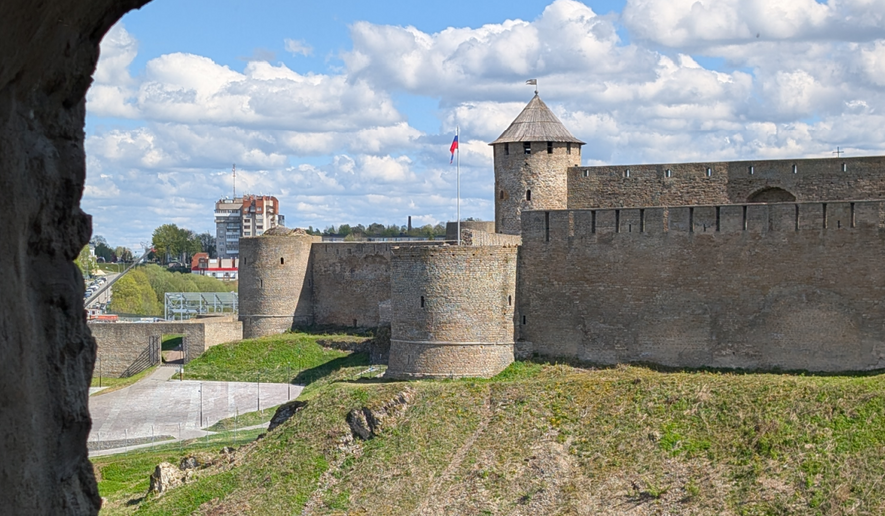
In Narva, right next to the border crossing, is a medieval castle that has become a museum dedicated to the city’s and Estonia’s history.
Mirrored across the Narva River is a similar Russian fort. On May 9, during a Russian “Victory Day” concert, a stage was erected on the Russian side of the river facing Estonia.
The concert broadcast a speech by Mr. Putin as images of the Soviet-era hammer and sickle and references to Russian military campaigns throughout history hung nearby. Some signs read “1945-2026 Victory will be ours!”
Some Russian-speaking Estonians watched the spectacle from the Narva side of the river.
“They start from 9 o’clock a.m., and they finished this year at 11 o’clock p.m.,” the Estonian museum’s director, Maria Smorzevskihh-Smirnova, said during a recent presentation at the museum. “The message is actually very, very clear: clarification of Russian military power and a symbolic eraser of borders.”
Over the years, Ms. Smorzevskihh-Smirnova has hung banners from the Estonian museum’s walls facing Russia, calling Mr. Putin a war criminal and comparing him to Adolf Hitler. Moscow has apparently noted these actions.
Ms. Smorzevskihh-Smirnova said a Russian court has prosecuted her in absentia and sentenced her to 10 years in prison in Russia.
“They say, ’One country, one victory.’ They say it. For us, silence in this situation is not an option,” she said. “I have never been a Russian citizen. Never. I am Estonian. I live in Europe.”
When vehicles were still allowed across the Narva River, a billboard on the Russian side, as drivers entered Estonia, read, “Russia’s borders do not end anywhere.”
The phrase is shown as a quote, with Mr. Putin and a large brown bear featured in front of a background of the Russian flag.
In his interview with The Times, Mr. Puusepp recalled a saying that captures the pressure Estonia faces and the immediacy of the threat.
“They say China is like climate change. Russia is bad weather,” he said. “There’s no such thing as bad weather, only bad clothing. We’re doing quite well enjoying our lives here.”
Contact the author


Please read our comment policy before commenting.